ChatGPT Trusted Us. It Just Didn't Recommend Us.
Our AI citations grew nine times over. Our AI leads fell 42%. Both were true.
The short version: For months our team tracked one number — how often AI assistants cited Kraftshala. It went up about nine times over. In the same window, leads from AI fell 42%. When I looked at why, I found we had become a source ChatGPT quoted and not a brand it suggested. On one query, ChatGPT opened our own blog, used it as evidence, and recommended three competitors out of it.
What we believed
More citations means more AI visibility. More AI visibility means more leads. So citations became the team's main number.
It is the obvious metric. It is also the one every GEO tool puts in front of you first, which is part of why it spreads.
What actually happened
Between May and August, traffic from AI assistants fell 34% and leads from AI fell 42%.
Meanwhile, citations went up about nine times over.
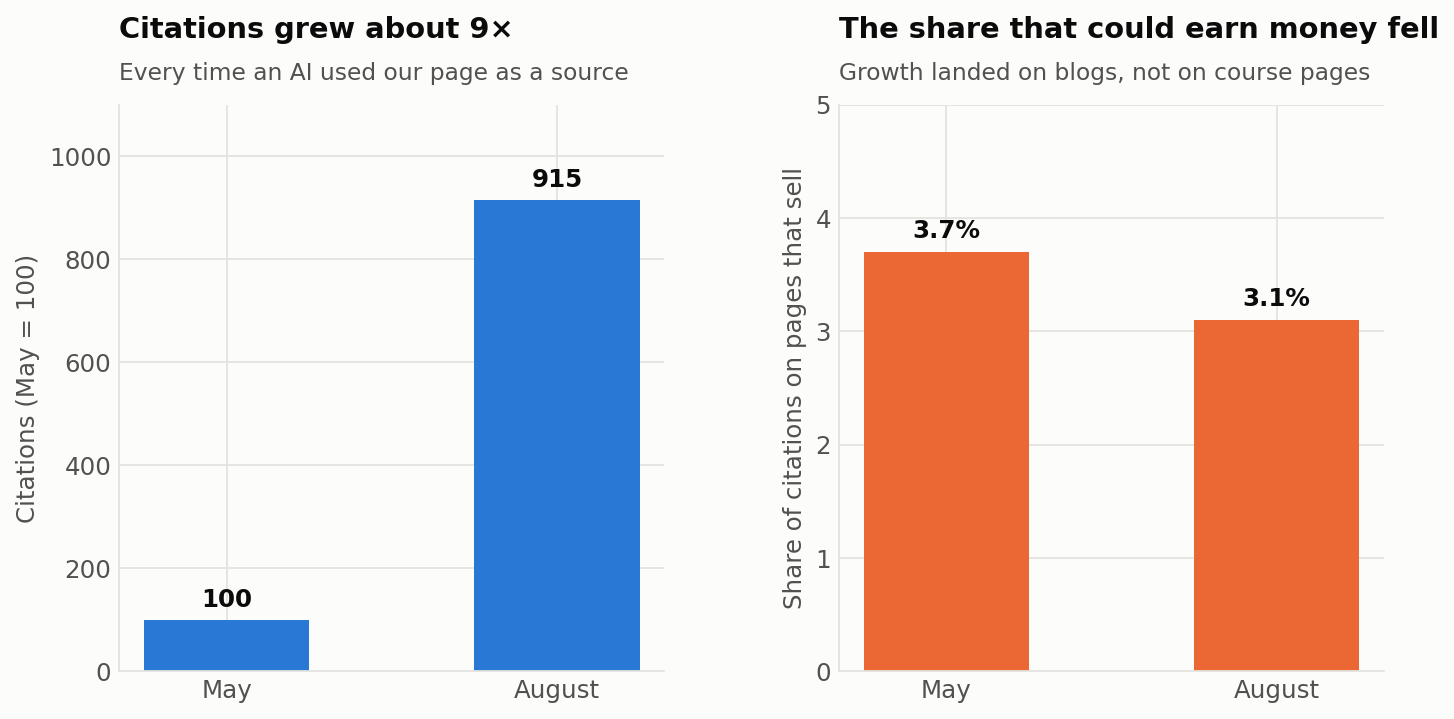
Look at the second chart. That is the finding.
Nine times the citations — and a smaller share of them on pages that actually sell a course. The growth was real. It landed almost entirely on informational blog posts: "career growth strategies", "government skill development courses", "MBA colleges without an entrance exam".
Useful pages. None of them sell anything.
Where the traffic actually went
Breaking the decline down by landing page made the shape clearer.
| Landing page | Share of total traffic decline |
|---|---|
| Homepage | 71% |
| Main course page | 28% |
| Every other page combined | grew 8% |
Almost all of the loss sat on two pages. Those two pages are where someone lands when ChatGPT recommends you. Blog pages — where you land when ChatGPT quotes something — held up fine and actually grew.
That split is the whole diagnosis in one table. Source traffic was healthy. Recommendation traffic had collapsed.
The number that explained it
I ran a live check across our five most commercially important buying queries — things like "best digital marketing course with placement".
Across all AI surfaces combined we looked strong: joint first place for coverage against every competitor tracked. But 95%+ of our AI traffic comes from one place.
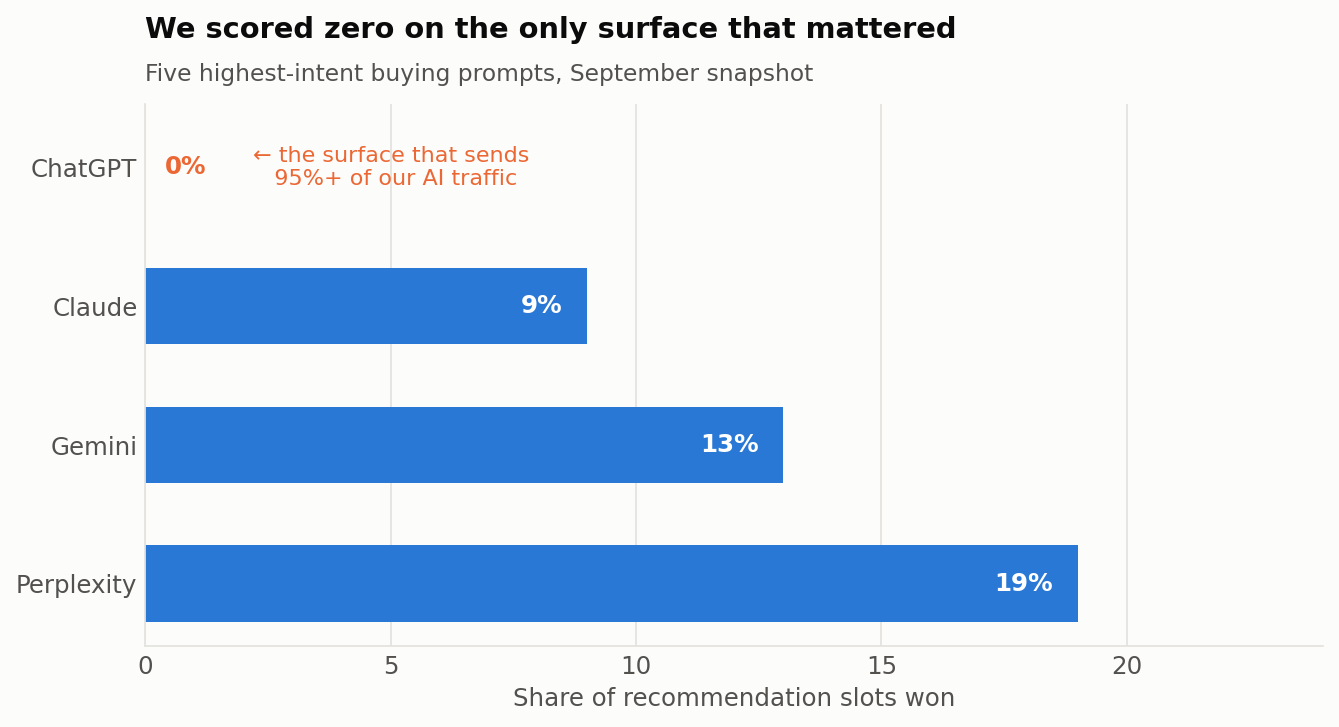
On ChatGPT, across five answers and fifteen available recommendation slots: zero. Not ranked low. Absent. Eleven other brands were named instead.
The combined "all surfaces" score had been flattering us and hiding the only number that pays.
The worst example
On one city-specific query, this is what ChatGPT did:
- Opened a Kraftshala blog post
- Cited it as the source for its answer
- Recommended three competitors — two of whom we had named on that page ourselves
We were supplying the evidence that got our competitors chosen.
That is not a content quality problem. On the exact query where our claim is strongest — courses with placement support — we are recommended on five of six AI surfaces and rank first on three of them. Our proof is good enough to win everywhere except the one place that matters.
What changed
We retired citations as the team's main number. It was measuring effort, not outcome.
The new number: the percentage of high-intent buying queries where Kraftshala is both recommended and linked. It sits directly upstream of the traffic we lost. Citations does not.
We paused new informational content. We had already proved we could earn citations. More blog posts would earn more citations and no more leads.
We started removing competitor names from our own "best" and "placement" pages. Naming a rival on your own page teaches the model that the rival belongs in the consideration set. We had been training it to do that for months.
The principle
Being cited and being recommended are different outcomes with different causes. Optimising for the first can actively serve your competitors.
A model quotes you when your page has a clean, checkable fact it needs. It recommends you when it has been convinced you are the right answer. Those require different assets:
| To get cited | To get recommended |
|---|---|
| Clear, extractable facts | Third-party proof — reviews, press, forums |
| Good structure, tables, FAQs | Strong organic rank on the buying query |
| Freshness signals | Your own page not naming rivals |
| Informational depth | Evidence on the page that sells |
Most GEO advice is about the left column, because the left column is easier to do and easier to measure. The right column is where the money is.
A question for your own reporting: if your AI visibility number doubled tomorrow, would you know whether you had gained customers or just gained quotations?
What I'd flag
The 0% ChatGPT result is a single-day snapshot — five queries, one run each, India. Zero out of fifteen is too large to be a sampling accident, but it is not yet a trend. A recurring tracker was built before any recovery claim gets made.
The citation growth figure is directional. The measurement windows are not perfectly matched, so treat the mix as the finding, not the exact multiple.
And attribution was degrading over the same period — AI leads arriving with no recorded first source went from about a quarter to nearly half. Some of the measured decline may be lost visibility rather than lost visitors. That is a separate problem, and knowing it existed mattered more than pretending it didn't.
# Data: GA4, CRM exports, Google Search Console, Bing grounding data, Ahrefs Brand Radar, and a live multi-engine visibility baseline. May 2026 compared with August 2026.
cd ~/blog